


Every conversation about Latino venture capital eventually arrives at the same number. Less than two percent of venture funding reaches Latino founders. It gets cited so often it has become wallpaper, a statistic everyone nods at and nobody interrogates.
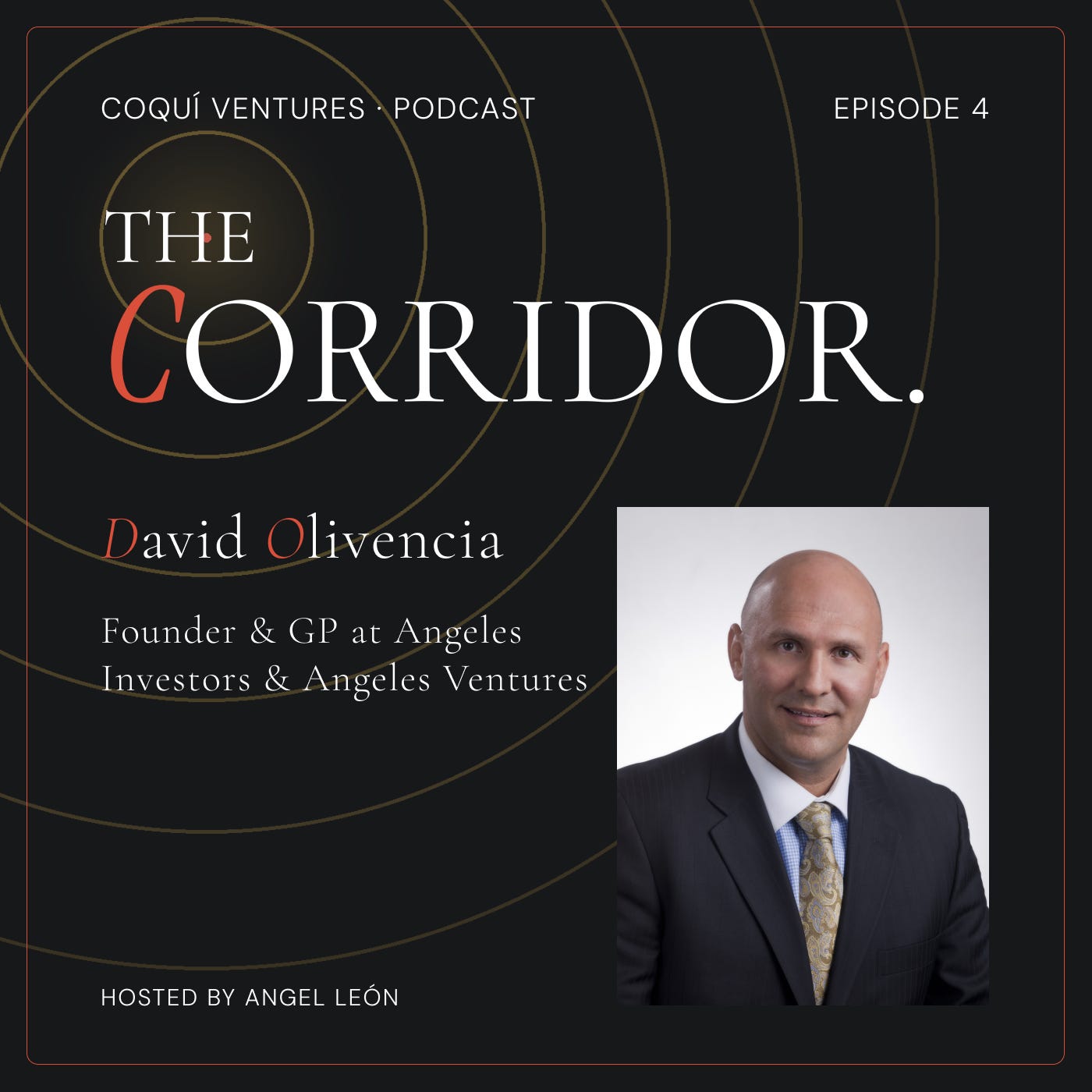
So on Episode 4 of The Corridor, I sat down with someone who actually lives inside that number. David Olivencia is the Co-Founder and CEO of Angeles Investors, one of the fastest-growing Latino angel investing groups in the country, and General Partner of a venture fund backed by Bank of America, the State of Illinois, and roughly ninety other limited partners. He has personally invested in about 80 different startups over the past 15 years. If anyone has earned the right to explain what the two percent statistic actually means, it is him.
Why he walked away from the obvious path
David’s path was not supposed to lead here. Born outside Chicago to a family from Puerto Rico, first in his family to take the technology route, he became a senior technology executive across multiple Fortune 100 companies and earned an MBA from Notre Dame. That is a career most people protect, not abandon.
But somewhere along the way he fell in love with startups and started investing about 15 years ago. Six years ago, he and several co-founders built Angeles Investors with a simple mission: leverage the power of Latino growth to find, fund, and fuel the best ventures in America. Today that group has grown to roughly 700 members and 30 sponsors, including some of the top banks, law firms, and accounting firms in the country, with a portfolio of about 30 companies.
I asked him directly why this became the thing he could not walk away from. His answer was not sentimental. “We saw that there was a void to fill,” he said, but quickly added, “it’s not by no means charitable. We think there’s a huge opportunity to leverage the power of Latino growth to find, fund, and fuel the best ventures in America.” He believes the firm can deliver outsized returns precisely because everyone else is mispricing the opportunity.
What he understands that other investors miss
I pushed him on what he actually sees in Latino founders that other VCs do not. His answer cuts straight to the structural problem.
“They may not come from the right schools. They may have a different accent. They may have only spent a few years in the United States,” he explained. Traditional venture firms are in the business of minimizing risk, and that profile reads as risk to them, even when it isn’t. The second piece is access. Venture, at its core, runs on networks and who you know, and many founders in the Latino community simply were not handed that network growing up.
That combination, misread risk plus missing network, is the actual mechanism behind the two percent. Not a lack of talent. A lack of proximity.
The math behind the gap
I asked him to size the actual capital gap. His answer made the scale of the problem concrete in a way the statistic alone never does.
He estimated there are roughly ten venture firms focused specifically on Latino growth, with maybe a billion dollars total to deploy among all of them. Against an industry that raises roughly $300 billion a year in venture capital, with a handful of mega-deals absorbing a disproportionate share, that billion dollars barely puts a dent in the gap.
Even more striking: the number of general partners who are Hispanic or Latino is itself only around one percent. The two percent funding gap and the one percent GP gap are the same problem, viewed from opposite ends of the table.
Why pre-seed is where the real gap lives
This is the part of the conversation that matters most for what I am building with Coquí Ventures. I asked David where he saw the biggest structural gap in the Latino startup ecosystem.
His fund operates primarily at the seed stage, and roughly ninety percent of startups he sees are operating at the pre-seed phase trying to get to seed. Of those, only about ten percent make it to seed, and less than one percent reach Series A. If you are a pre-seed fund focused on Latino founders, you are pitching investors who may not be Latino themselves, because there are so few funds operating at that earliest stage.
He was candid about his own fund’s limitation here: “We don’t do pre-seeds.” That gap, the space below seed where almost nobody with cultural proximity is writing checks, is exactly the room Coquí Ventures exists to stand in.
AI is changing who gets to start a company at all
One of the more interesting threads in our conversation was about artificial intelligence, and not in the way most people expect. David pointed to something structural happening in venture itself.
With AI, the cost to start, scale, and grow a startup has dropped dramatically and keeps getting cheaper, meaning the same $50,000 or $100,000 check produces dramatically more impact today than it did five or ten years ago.
He also noted a deeper shift in what a startup team even looks like now. Roughly half of a recent Y Combinator cohort were solo founders, leveraging AI to do what used to require a full team. He went further, predicting the next evolution may be startups run almost entirely by fleets of AI agents, with perhaps just an owner and a board to guide decisions.
For underfunded founders, this should be read as opportunity. The barrier that used to require a technical co-founder, a development team, and months of runway is collapsing. The capital gap remains, but the capital required to close it per founder is shrinking.
Culture as thesis, not decoration
I asked David the question that sits underneath everything Coquí Ventures is built on: should culture itself be a venture thesis, not just a demographic detail?
His answer was a useful gut check for anyone building a culturally-rooted fund. “You gotta pick a thesis that you believe in, that you can defend, and that you’re gonna go pitch investors on, where they’re gonna believe in you and the thesis and why they should give their hard-earned money to you versus all the other alternatives.” He was direct that you do not have to be part of a culture to recognize the business case behind it, using the example that he could evaluate an Alaska-based fund with an energy or tourism thesis purely on the strength of its logic and track record.
The lesson is not that culture does not matter. It is that culture has to earn its place in the thesis the same way any other edge does, through growth, defensibility, and proof.
What it would take to close the gap in ten years
I closed by asking him to look forward. What needs to be true in a decade for the two percent to actually move?
His honest answer was that if nothing changes, demographic growth alone will move the number eventually, since Latinos are projected to make up thirty to forty percent of the US population. But waiting on demographics is not a strategy. The real lever is building more Latino general partners, more people who see venture capital as a viable career path, because right now that number is roughly as small as the funding gap itself. That means exposing more people in the community to the asset class itself, and to what a career in venture actually looks like.
That is the long game. Coquí Ventures, The Corridor, Angeles Investors, and the handful of funds doing this work today are not just deploying capital. They are training the next generation of people who will deploy it after us.
You can also find The Corridor on Apple Podcasts, Spotify, and YouTube.


